INTERNET HISTORY.EXE Origins WWW Personal Web Hoaxes Communities Flash Era
CONNECTING TO REMOTE HOST...

A HISTORY OF THE INTERNET

Before feeds, apps, influencers, and algorithms, the Internet was a different place.

This archive follows the web from research networks and plain documents to personal homepages, online hoaxes, fan communities, imageboards, Flash games, and the web of the 2000s.

The farther you scroll, the newer the Internet becomes.

[ ENTER ]
1960s — 1980s

01. BEFORE THE WORLD WIDE WEB

The Internet and the World Wide Web are not actually the same thing. The Internet is the enormous network of computers and networks that allows machines around the world to communicate. The World Wide Web is only one system that operates through it.

During the 1960s, researchers were experimenting with ways for computers in different locations to exchange information. One of the most important early networks was ARPANET, a project funded by the United States Department of Defense's Advanced Research Projects Agency.

Early networked computing looked nothing like browsing the Internet today. There were no colorful websites to click. Users often communicated through terminals using typed commands.

Over time, technologies and common networking standards allowed separate computer networks to communicate with one another. This interconnected system eventually developed into what we now call the Internet.

IMPORTANT: The Internet existed before websites. People were already sending messages and sharing data electronically long before the Web was invented.
An old computer.
1989 — 1993

The World Wide Web

In 1989, while working at CERN, British computer scientist Tim Berners-Lee proposed a system for organizing and connecting information through hypertext. His goal was to make it easier for researchers to share information.

This project became the World Wide Web. Berners-Lee developed several pieces that remain fundamental to the Web: HTML for structuring pages, HTTP for transferring them, and URLs for giving resources addresses.

The first website was hosted at CERN. Compared with modern websites it was incredibly plain. It was essentially text and hyperlinks explaining what the World Wide Web was and how someone could use it.

What did an early webpage have?

  • Text
  • Headings
  • Lists
  • Blue hyperlinks

Click a link. Read another document. Click another link.

The earliest Web was primarily made of documents connected through hyperlinks.
WELCOME TO THE WORLD WIDE WEB!

☆ WHAT DID OLD WEBSITES LOOK LIKE? ☆

WELCOME WELCOME WELCOME WELCOME WELCOME

As the Web expanded during the 1990s, ordinary people began experimenting with HTML and building pages about themselves, their hobbies, favorite things, bands, pets, and almost anything else they could think of.

There was no universal idea of what a website was "supposed" to look like. That made the early Web incredibly personal.

Common decorations included animated GIFs, tiled backgrounds, giant rainbow text, horizontal divider graphics, guestbooks, hit counters, and tiny buttons. Websites might automatically play music. Text might blink. A mouse cursor might trail stars. Pages were often built with tables or frames simply because designers were improvising with whatever HTML could do.

Professional web-design standards gradually developed, but the amateur Web never completely disappeared. Modern personal-hosting communities such as Neocities deliberately preserve some of this older style.

COMMON ADDITIONS ON THESE PAGES:

★ VISITOR COUNTERS
★ GUESTBOOKS
★ WEBRINGS
★ 88×31 BUTTONS
★ TILED BACKGROUNDS
These are some early sites of Apple, Cartoon Network, and Nokia.

WELCOME TO GEOCITIES!!!

☆ ★ ☆ YOU ARE VISITOR #00038192 ☆ ★ ☆

Building a Home on the Internet

GeoCities became one of the first services of the personal Web. Instead of thinking of websites as files stored on servers, here they were presented as a kind of virtual city.

Users created their own free webpages and originally placed them inside themed "neighborhoods." A page about Hollywood or celebrities might belong in one area while science fiction, computers, or other interests had their own neighborhoods.

Millions of people used services like GeoCities to create a space online before social-media profiles became the main way of expressing yourself on the Internet.

A GeoCities site could be a diary, fan shrine, family homepage, conspiracy page, poetry collection, recipe book, roleplaying page, or a page devoted entirely to one person's cat. It is important to also note that Google image search did not exist early on in geocities life, so the only way to find images online was to go to a specific personal page that collected them. and usually, this happened on Geocities.

GeoCities was discontinued in 2009. Its disappearance also demonstrated one of the biggest problems with digital history: a huge piece of culture can disappear when the company hosting it closes. Preservation projects and web archives rescued portions of the old GeoCities site, which can now be viewed on the "Geocities Archives".

These are some examples of Geocities sites.
SIGN MY GUESTBOOK ★ EMAIL THE WEBMASTER ★ JOIN MY WEBRING ★
YOU HAVE 1 NEW MESSAGE

THE BLAIR WITCH PROJECT

In the late 1990s, the Internet saw a new kind of advertising.

The marketing surrounding The Blair Witch Project blurred the boundary between fiction and reality. The film presented itself through found footage, while online material expanded the supposed history surrounding the missing filmmakers and the Blair Witch legend. So instead of advertising the movie only as a conventional horror release, the campaign encouraged audiences to enter its fictional world.

For viewers encountering this kind of marketing before it had become commonplace, determining where promotion ended and fiction began could be part of the experience.

Its online presence became an important early example of how the Web could be used to make the audience feel as though they had discovered pieces of a story themselves.

Years later, alternate-reality games, and many internet horror projects, would use similar techniques such as fictional documents, hidden clues, mysterious websites, and media presented without giviing away that its not real.

BONSAI KITTEN

Bonsai Kitten is one of the best and most famus examples of an early internet hoax escaping its original context. The website appeared around the beginning of the 2000s and claimed that kittens could be raised inside glass containers so that their bodies would grow into the shape of the container.

It was not real. The site was a deliberately disturbing parody. No kittens were being grown inside jars.

That did not stop the page from causing enormous outrage. Messages warning people about the supposedly cruel website spread online, animal-welfare organizations received complaints, and the controversy even attracted the attention of law enforcement.

Bonsai Kitten is useful as Internet history because it shows how context can vanish when information is copied. Someone might receive an angry email describing the site without ever visiting it. They would then forward the warning to someone else, who would repeat it again.

The above image is a placeholder, because the og site itself is a bit disturbing, even though its fake.

ROTTEN.COM & THE SHOCK SITE

⚠ CONTENT WARNING: This section discusses graphic and disturbing websites without reproducing their graphic material.

Not every corner of the early Web was friendly. Some websites became famous precisely because they contained material most people would never expect to encounter elsewhere.

Rotten.com became one of the most notorious examples. Its reputation was built around morbid, disturbing, and extremely graphic material.

The Shock Site

During the late 1990s and 2000s, "shock sites" became a recognizable form of Internet prank culture. Some existed almost entirely because people dared other users to visit them. A link might be deliberately mislabeled and sent to an unsuspecting friend. Instead of receiving the promised funny photograph or game, the victim was shown graphic, sexual, or otherwise disturbing material.

There were also "screamers": pages or games designed to make a user concentrate on something harmless before suddenly displaying a frightening face or playing a loud scream.

DO NOT TRUST RANDOM LINKS.

The tradition eventually developed much friendlier descendants. A Rickroll uses essentially the same bait-and-switch structure without exposing someone to graphic content.

> TED THE CAVER_

Before "creepypasta" became a familiar word, frightening stories were already spreading through personal webpages, forums, chain emails, and other online journals.

Ted the Caver is one of the most famous surviving examples of early Internet horror.

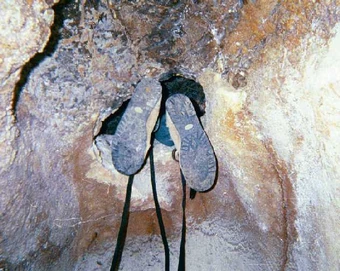
The story takes the form of an real online account written by a caver named Ted. At first, the page appears to document a genuine cave exploration project. Ted and his companions discover a narrow passage and gradually work to widen it so that they can explore what lies beyond.

Photographs and journal-style updates help the page resemble an ordinary hobbyist website. Then things become increasingly wrong.

Strange things begin happening around the cave. The journal's documentary style makes the horror effective because readers encounter the story in the same format as thousands of completely sincere personal webpages. This style of Internet horror would become enormously influential. Ted the caver was also special in the sense that the man who wrote it was actually a caver, which is where he got his pictures from. He also did not tell anyone that this story was not real, and as he would continue to update it, his own family became concerned. Of course he told them it was all fake, but no one else online knew that for a long while.

The above images are from the og story.
FANDOM

FanFiction.Net

Fanfiction existed long before the Internet. Fans had been creating and sharing stories through printed magazines, clubs, and other communities, for decades.

FanFiction.Net launched in 1998 and provided a centralized online archive where users could upload stories inspired by books, films, television shows, anime, games and other media. Instead of finding stories scattered across individual fan pages or mailing lists, readers could browse categories and discover enormous collections of fan-created writing in one place.

Reviews also made fanfiction social. Readers could now leave responses for an author chapter by chapter, or favorite stories, and follow writers.

FANDOM VOCABULARY:

FANFIC • SHIP • OTP • AU • OC • CANON • HEADCANON • CROSSOVER • REVIEW
An old screenshot of FanFic.net.

SOMETHING AWFUL

THE INTERNET MAKES YOU STUPID

Something Awful began in 1999 and became one of the most influential comedy communities of the early social Web.

The site included articles, comedy features, edited images and, most importantly for Internet culture, an enormous forum community.

Before social-media feeds made up much of online discussion, forums were destinations. Users returned to the same boards, recognized one another's usernames and developed their own slang, rivalries, jokes and social rules.

Something Awful's forums became an incubator for online humor, Photoshop contests, Let's Play culture, and numerous memes and projects that eventually escaped into the wider Internet.

The cheerful personal-homepage Web of the 1990s had not disappeared, but another culture was growing beside it.

People were really mean on this site : (
The above image is from 2001.

deviantART

DeviantArt launched in 2000 and developed into one of the Web's largest communities for artists.

Early DeviantArt was initially connected to customization culture, including user-created computer skins. But it quickly expanded far beyond that beginning. Illustrators, photographers, digital painters, Flash animators, fan artists, and countless hobbyists could upload work directly to galleries attached to their profiles.

The OC Internet

DeviantArt became particularly important to young artists growing up online.

Original characters could develop entire communities of their own. Artists traded characters, created adoptables, used drawing bases, joined groups, posted tutorials and participated in drawing challenges.

Fanart also flourished. Someone obsessed with an anime, cartoon, video game, or band, could immediately find hundreds of other people drawing the same thing.

It was the first place online really MEANT for art. It would go on to influence much of the wider web, sometimes for better, and osmetimes for worse. It gave young artists a way to share their art without the need for having a hard to find personal blog or website, which again, is why its important.

4CHAN


Anonymous 08/19/03

4chan was created in 2003 as an English-language imageboard inspired by Japanese imageboard 2chan.


Anonymous

> no permanent identity required
> imageboards organized by topic
> threads disappear as new posts replace them
> things spread beyond the website

4chan looked remarkably plain compared with the increasingly polished websites surrounding it. Boards were built around rapidly moving threads where users could post images and text, often anonymously.

That anonymity became central to the site's identity. Rather than building a permanent profile with a biography and list of friends, a user could simply appear as "Anonymous."

4chan became one of the most influential (and controversial) communities in Internet history. Memes, reaction images, slang, collaborative pranks, and the Anonymous identity all spread outward from imageboard culture.

At the same time, portions of the site became notorious for harassment, bigotry, deliberately offensive material, and a culture that often celebrated violating ordinary social boundaries.

Its history therefore represents both sides of anonymous online culture: remarkable collective creativity AND the ability for cruelty to flourish when people feel detached from their real identities.

2003 — 2008 : THE SOCIAL WEB
MySpace.com | A Place for Friends

MYSPACE

Internet History's Info:

MySpace brought many aspects of the personal homepage into the age of social networking.

Users had profiles, friends, comments, photographs and music, but crucially they could also heavily customize the appearance of their pages.

Background photographs competed with glitter graphics. Embedded videos fought with enormous images. Songs began playing automatically. Text became nearly impossible to read. The page might take forever to load.

MySpace also became enormously important for musicians. Artists could host music directly on their profiles and attract listeners without depending entirely on traditional media.

Social networking was becoming centralized, but users still expected their little portion of the Internet to look like theirs.

Your Friend Space

You have 38 Friends.

Tom
Mia M
DarkEmoGuyXx
YourBud13

NEWGROUNDS

Newgrounds grew into one of the defining communities of the Flash-era Internet. Users could submit animations, games and other creations while audiences rated and discussed them.

Flash dramatically lowered the barrier between "watching a website" and interacting with it. A webpage could contain cartoons, menus, music, games and elaborate animation.

Newgrounds encouraged amateur creators to publish directly to an enormous online audience. A teenager working on a computer at home could make something weird, upload it and potentially have thousands or millions of strangers see it.

THE FLASH WEB

Flash games and animations spread through portals including Miniclip, Armor Games, Kongregate, AddictingGames and countless smaller sites.

For an entire generation, "playing a computer game" could simply mean opening a browser during school and finding a site that the network administrator had forgotten to block.

Broadcast Yourself: YouTube

Video had existed online long before YouTube, but watching it could be awkward. Files were large, connections were slow and websites often depended on different media players or plugins.

YouTube helped make uploading and watching user-created video much simpler.

Me at the zoo — 2005

On April 23, 2005, YouTube co-founder Jawed Karim uploaded a short clip of himself standing in front of elephants at the San Diego Zoo.

Something as simple as a person talking into a camera would soon become the foundation for an entirely new form of celebrity, entertainment and communication.

★ the first video uploaded to YouTube ★

✿ ★ GAMES FOR GIRLS!!! ★ ✿

GirlsGoGames.com ♡

DRESS UP! ✿ COOK! ✿ MAKEOVER! ✿ DECORATE! ✿ PLAY!

★ Dress Up Game
♥ Makeover Game
☆ Cooking Game
♡ Room Designer

Girls Games

Browser-games developed an enormous industry of websites marketed specifically toward girls.

GirlsGoGames became one of the most recognizable examples. Sites like it collected huge numbers of simple browser games into one brightly colored page.

Fashion and dress-up games were everywhere. So were cooking, makeup, interior design, pet care, dating, weddings, babysitting and celebrity makeover games. Their visual language was equally recognizable: pink, purple, rounded buttons, sparkles, hearts and photographs or illustrations of fashionable girls.

These websites provide a fascinating snapshot of how companies imagined the young female Internet user.

"Games for boys" were often marketed around fighting, sports, driving and action. "Games for girls" frequently focused on beauty, domestic activities, relationships and fashion.

That does not mean girls disliked those games. Many did and still remember them fondly. But the categories reveal the assumptions advertisers and game portals made about what each gender was supposed to enjoy.

★ WHAT IS AN ADVERGAME? ★

An advergame is a game created partly or primarily to promote a company, product, movie, television series or other brand.

Instead of displaying a banner advertisement that a child could ignore, a company could make the advertisement itself into something the child actively wanted to play.

Advertising Games to Girls

Dolls, clothing companies, children's television networks, toy manufacturers, restaurants and food brands all experimented with browser games.

A branded game might allow the player to dress a character in products, decorate a room, prepare a branded snack or explore a world populated by characters connected to merchandise. The distinction between entertainment and advertising became unusually blurry.

Where Did the Old Internet Go?

By the end of the 2000s, the Web was becoming more centralized.

Instead of building an independent homepage, people increasingly created accounts on enormous platforms. Instead of visiting a collection of favorite websites individually, users could open a social-media feed and allow content to come to them.

Smartphones changed web design again. Websites needed to fit small touch screens. Elaborate Flash pages became impractical. Adobe eventually discontinued Flash Player at the end of 2020. Custom profiles became standardized. Automatic music disappeared. Websites became cleaner, faster and easier to navigate.

The old Web was frequently ugly, frustrating, unsafe and difficult to navigate. But it also gave ordinary users an unusual amount of control over how they presented themselves.

Today, web archives preserve pieces of that world while independent sites, small communities, and services such as Neocities, have revived interest in making personal websites again.

Maybe the personal Web never completely died.

FUTURE SECTIONS TO ADD:

AOL & Dial-Up • Netscape • Webrings • Chain Emails • Napster & LimeWire • AIM • LiveJournal • Tumblr • Creepypasta • ARGs • Internet Archive • Flash Preservation

↑ Back to the Encyclopedia ← Back to Educational Page